
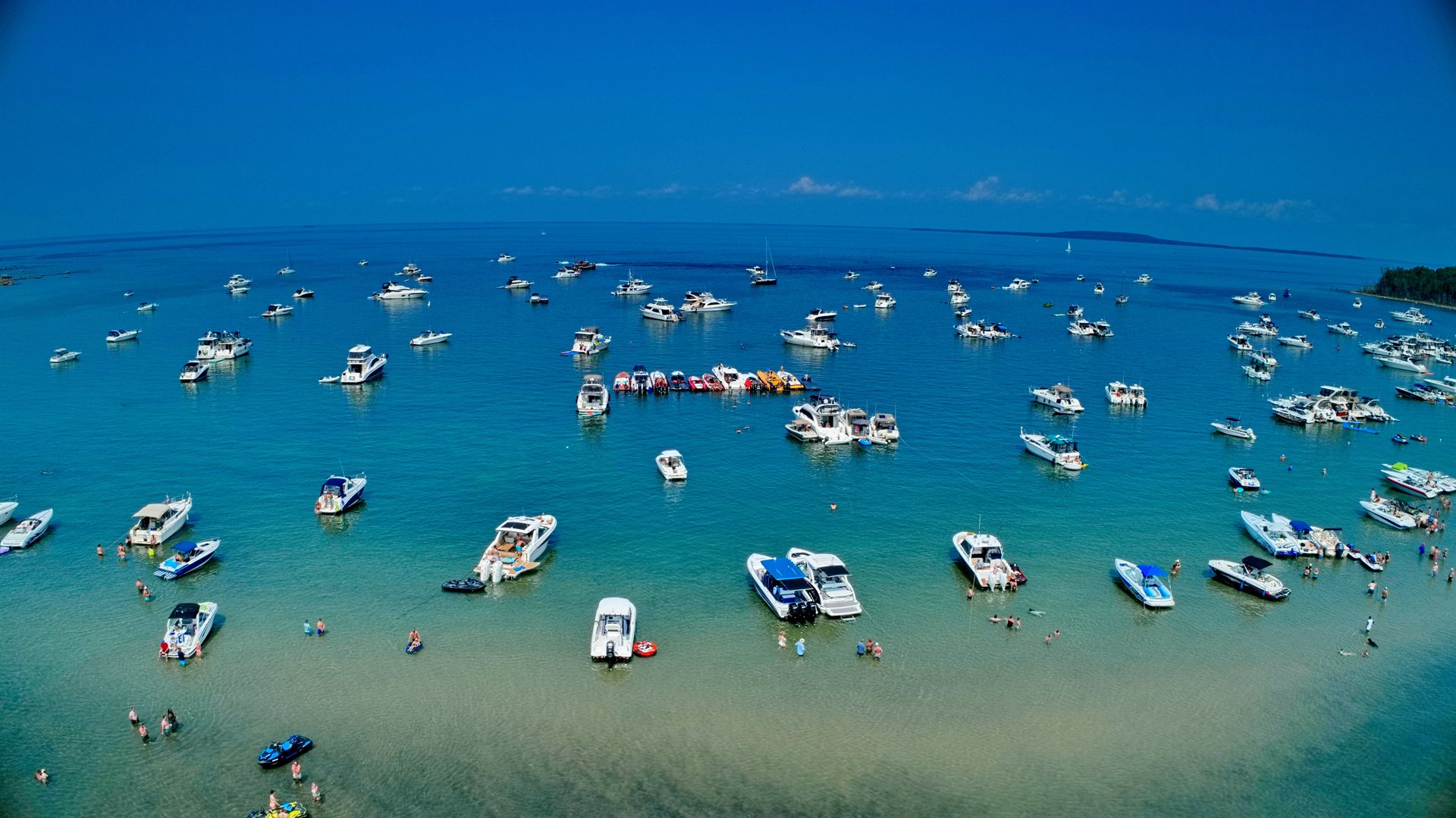
Walk any marina this season and you'll see it: clean, capable boats sitting in the same slips month after month. Sellers wondering why the phone stopped ringing. Buyers circling, waiting, unsure whether the listing in front of them is an opportunity or someone else's problem.
Neither side is wrong to be cautious. The market has genuinely changed. But the change is widely misread — and misreading it is costing sellers real money and costing buyers good boats.
Here's what the data actually says, and what to do about it.
The Market by the Numbers
New powerboat retail sales in the U.S. fell 8.8% in 2025, to roughly 215,000 units — the fourth consecutive year of decline from the 2021 pandemic peak. But the headline number hides the real story: the used market is where boating actually happens. Pre-owned transactions run close to 860,000 units a year — nearly four out of every five boats sold in America is a used boat.
When that market slows, everything slows. And it has slowed. New boats are now averaging over 240 days on the market; used boats around 165. A listing that sits past 90 days at a given price is the market telling you it disagrees with that number.
The Four Drivers Behind the Cooling
1. Financing costs killed the marginal buyer.
Marine loan rates that ran below 4% in 2020–2021 now sit at 7–10% for well-qualified borrowers. On a $150,000 financed purchase over 15 years, that difference is roughly $400–500 a month — enough to remove an entire tier of buyers from the market. The pressure is heaviest exactly where the used market lives: entry and mid-level segments.
2. The pandemic cohort is unwinding.
Buyers who entered boating in 2020–2021 are now four to five years into ownership costs they never fully priced: slip fees, insurance, maintenance, storage. Many are exiting at the same time, adding supply into a market with fewer qualified buyers.
3. Carrying costs keep rising.
Insurance is the sleeper issue — double-digit premium increases in coastal markets, tighter underwriting, higher deductibles, and storm-plan requirements that didn't exist five years ago. A boat that “just sits” still costs its owner thousands per year, and every one of those months erodes both condition and negotiating position.
4. The market is no longer uniform — and that matters.
This is where most commentary gets it wrong. This isn't a demand collapse. It's a utilization filter. Fishing boats — boats that get used 40+ days a year — were down barely 1–2% in 2025. Meanwhile pontoons dropped roughly 11%, wake boats 9–14%, and sterndrives about 20%. The market isn't rejecting boats. It's rejecting under-used, under-documented, and over-priced boats.
What This Means If You're Selling
Buyers with a hundred comparable listings don't negotiate uncertainty — they walk from it. Three things now set the price of your boat, in this order:
Proof of condition.
Maintenance documentation has become one of the strongest predictors of valuation in the current market. A complete service log, recent survey, oil analysis, and verifiable hour meter are no longer nice-to-haves — they are the difference between a transaction and a stale listing. Engine hours alone are being priced with near-actuarial precision: boats over 500 hours commonly take a 15–25% reduction; boats under 200 hours can command a premium.
Honest positioning.
Pricing on what you paid, what you owe, or what the boat means to you guarantees one outcome: your boat becomes marina furniture while carrying costs — often $15,000–$30,000 a year on a mid-size cruiser — bleed the “savings” of waiting.
Presentation.
Current photos, accurate specs, disclosed defects. Today's buyers cross-reference everything. The first inconsistency they find ends the conversation.
What This Means If You're Buying
It's a buyer's market — but only for buyers who know what they're looking at. The same conditions creating opportunity are creating traps:
Deferred maintenance is epidemic. Boats that sat through the slowdown didn't hold steady; they degraded. Systems corrode, seals dry, batteries sulfate.
Sterndrive platforms carry a structural discount now — a propulsion architecture the market is abandoning wholesale for outboards — and that discount compounds with parts availability risk.
A cheap boat with an incomplete history isn't cheap. It's an unpriced liability.
The best deals in this market are on well-documented boats from motivated sellers. Finding them — and verifying them — is technical work, not scrolling.
Talk to Us First
This is exactly the market Boater Ventures International was built for. Forty-five years of hands-on marine experience — hull design, composite fabrication, systems commissioning, forensic survey, and vessel operations from 14 to 98 feet — applied to one job: taking the risk, stress, and guesswork out of used-boat transactions.
For buyers:
Forensic pre-purchase surveys — in-depth technical assessment of structure, systems, and propulsion. Not a checklist walk-through; a defensible engineering evaluation of what the boat actually is.
Transaction advisory — comparable-market pricing analysis, negotiation support grounded in survey findings, and a clear-eyed read on which listings are opportunities and which are someone else's exit strategy.
Sea trials, delivery, and owner training — performance verification before you close, professional relocation after, and hands-on instruction so the boat you bought is a boat you can run.
For sellers:
Pre-listing condition assessment — find and fix the survey findings before a buyer's surveyor finds them for you. Every issue you resolve or disclose up front is negotiating leverage you keep.
Documentation packages — organized service history, systems condition reporting, and survey-backed listings that separate your boat from the hundred others on the page.
Market-accurate pricing guidance — where the market is, not where you wish it was. The goal is a clean, fast transaction at the strongest defensible number — not a year of slip fees waiting for a miracle.
For owners in between:
Owner representation on refits, repowers, and restorations — independent technical oversight so the money you spend actually shows up in the boat's condition and its resale value.
The market hasn't stopped rewarding good boats. It has stopped rewarding unverified ones. Whether you're buying, selling, or deciding what to do with the boat you have — talk to us first, before the market makes the decision for you.
Captain Carl McBride • Boater Ventures International Ltd. • Cameron, LA & Gravenhurst, ON. Direct inquiries through the consultation request form.