In the first piece in this series, I argued that no system belongs in service until it survives a sea trial. In the second, that on a new autonomous platform, an experienced human must define “normal” before the sensor suite or the autonomy stack can mean anything at all.
A fair reader might conclude I'm arguing human versus machine — the old hand against the algorithm, senses against sensors.
I'm arguing the opposite. And the distinction is the whole subject.
Two instrument suites, one trial
Walk a new vessel through shakedown and there are two sensing systems aboard, not one.
The first is biological: hands on the helm, feet on the deck, ears, eyes, nose, and an inner ear with decades of calibration history. The second is electronic: accelerometers on the struts, strain gauges in the hull, thermal sensors on the propulsion train, telemetry streaming everything to the record.
Each can do what the other cannot.
The human suite supplies meaning. Which vibration matters and which is character. What the harmonic at a certain RPM band implies about the shaft line. Whether the way she answers the helm is responsiveness or a warning. Where the forgiveness margin actually sits — how much notice she gives before she bites. No sensor reports significance. Significance is a judgment, and judgment is what forty-five years of confirmed outcomes calibrates.
The electronic suite supplies what the body cannot. The frequency spectrum inside the vibration I felt. The half-millimeter of misalignment no hand detects. The thermal signature climbing before anything smells hot. Perfect memory. Vigilance that never fatigues, never expects, and never wants the answer to come out a particular way.
Neither suite, alone, defines an operational envelope. Senses without instrumentation produce judgment that cannot be examined and dies with the operator. Instrumentation without senses produces precise measurements with no concept of which ones matter — numbers waiting for someone to tell them what they mean.
The calibration runs both ways
Here is what the commissioning textbooks don't say plainly enough: during a proper shakedown, the calibration is bidirectional, and it is simultaneous.
I am teaching the sensor suite what “aligned and balanced” looks like on this hull — correlating the traces to what my hands and ears verified, so that from this day forward the numbers carry meaning. That direction is familiar; it was the subject of the last article.
But the sensor suite is calibrating me at the same time. It quantifies my impressions. It catches what I missed. It puts a number on the hunch — and sometimes the number says the hunch was wrong. An operator who won't let the instruments correct him is as dangerous as a program that never let an operator teach them. I have been proven wrong by a strain gauge, and I trusted my hands more afterward, not less — because they'd been recalibrated against something that doesn't flatter.
The dialogue is the method. I feel an anomaly; the accelerometer tells me its frequency, and now we know which bearing to look at. The gauge flags a trend; my hands go find out whether it's real, and now we know whether the threshold holds. Each pass through that loop, the envelope gets sharper — not because either instrument suite got better, but because the agreement between them got tighter.
What commissioning actually commissions
Which leads to the claim this whole series has been building toward.
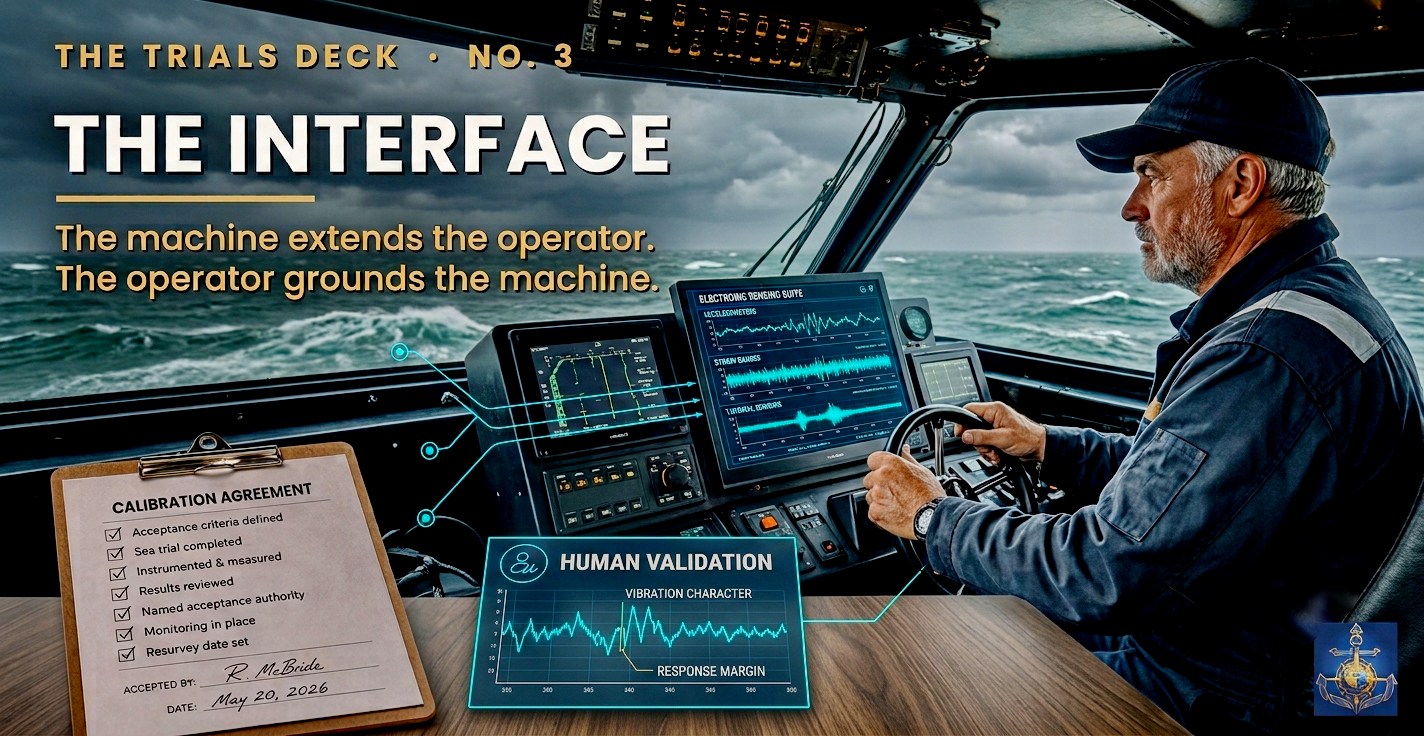
What gets commissioned during trials is not a hull plus its electronics. It is an integrated sensing system — with a trained human as one of its instruments — and the operational baseline is the documented record of that partnership reaching agreement about reality.
That reframing matters for autonomy programs, because it relocates the question. The debate keeps asking whether the human can be removed from the platform. Wrong layer. The human was never merely aboard the platform; the human is a constituent of the measurement system that defined what the platform knows. Remove the crew from operations — fine, that's what the technology is for. But the platform's entire concept of normal, safe, and acceptable was formed at the human-machine interface during commissioning, and it carries that formation for the rest of its service life.
Crewless in operation. Never interface-less in origin.
Three things learn during a shakedown
We are all learning as we go here — the operators, the platforms, and the industry writing its first commissioning doctrine for machines that keep some of the judgment aboard. A proper trial teaches all three at once.
The operator learns the vessel — her balance, her responsiveness, her forgiveness. The system learns its envelope — thresholds verified against reality instead of inherited from a factory assumption. And the industry learns the method — but only if the record is kept, because the instrumented trace correlated to the human verification is the only part of the partnership that survives the people in it.
That third one is the quiet obligation. The interface I'm describing gets built vessel by vessel, trial by trial, by whoever is standing on the trials deck. If we document what the partnership found — what the senses flagged, what the instruments confirmed, where each corrected the other — we are writing the calibration history the next generation of operators and platforms inherits. If we don't, every program starts from zero and calls it innovation.
First truths over jargon: the machine extends the operator. The operator grounds the machine. The baseline lives where they meet — and commissioning is where that meeting is built, witnessed, and signed.
Captain Carl McBride is the principal of Boater Ventures International LTD. He holds a USCG Master license (100 GT) and has spent 45+ years in high-performance hull design and fabrication, marine systems commissioning, propulsion R&D, forensic marine survey, and high-performance powerboat instruction and certification. The Trials Deck series examines how operational baselines are established, transferred, and inherited by autonomous marine systems.
No. 1 · The Sea Trial Problem • No. 2 · The Transfer Standard • No. 3 · The Interface (this piece) • No. 4 · The Understanding Problem