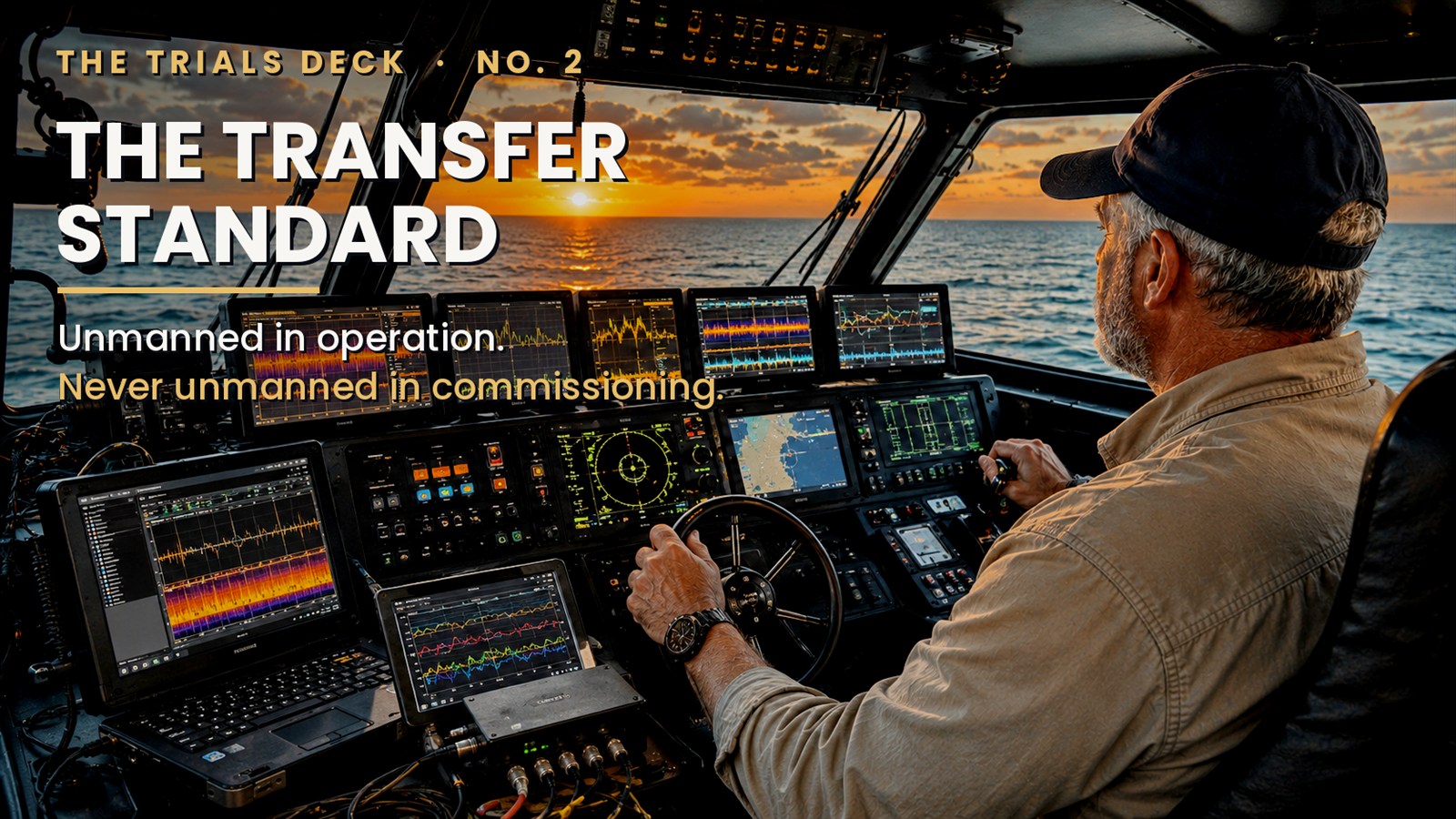
A new unmanned surface vessel enters trials. She's instrumented stem to stern: accelerometers on the struts, strain gauges in the hull, thermal sensors on the propulsion train, telemetry streaming to shore. Every one of those instruments will report numbers from the first minute.
Not one of those numbers means anything yet.
An accelerometer will dutifully report vibration at the shaft strut. Nothing in that reading says whether it's normal, marginal, or a misaligned shaft eating its bearing. On a clean-sheet design, there is no prior reference — no fleet history, no baseline, no library of what healthy looks like on this hull, in this water, at this loading. The sensors ship with precision but no meaning.
Somebody has to be the first reference standard.
The instrument with forty-five years of calibration history
In metrology, a transfer standard is the trusted instrument that carries calibration from a known reference to an unknown one. On a new vessel, that instrument is the experienced human at the helm.
This is why I take full manual control for initial shakedown — no autonomy, no assist. Hands, feet, ears, and inner ear are the only instruments aboard with decades of calibration history: thousands of hulls, sound and failed, with confirmed outcomes. The senses aren't folklore riding along with the engineering. They are the engineering. They were baselined the only way biological instruments can be — repeated exposure to known-good and known-bad, verified against what the teardown later proved.
Under manual control you learn what no spec sheet contains. Where she squats under load. Whether the propulsion train runs aligned, balanced, and vibration-free, or fights itself at certain RPM bands. How she answers the helm — and how much warning she gives before she bites. Balance, responsiveness, forgiveness. You find the operational sweet spots, and you find the deficiencies: the load imbalance, the harmonic that shouldn't be there, the trim condition the designer never met.
Only then does the electronic sensor suite get calibrated — against parameters a human verified, not parameters a vendor assumed. This accelerometer trace is what “aligned and balanced” looks like on this vessel. That pattern is the imbalance we found and corrected. From that moment forward, the numbers carry meaning, because someone established what the numbers were pointing at.
The chain runs one direction: physical reality, to trained senses, to operational baseline, to instrument correlation. Skip a link and everything downstream inherits the gap.
The sequencing violation
Here's the failure I see coming in autonomous programs: commissioning by factory threshold. The sensor suite arrives with default alarm limits, the software accepts them, and the platform goes to work. Nobody drove the vessel to its edges first.
That's the brochure problem, one layer down. The sensors aren't lying — they were simply never taught what truth looks like on this hull. An alarm limit set in a factory is a vendor's assumption wearing an engineer's uniform.
And the consequence compounds, because an autonomy stack inherits its entire definition of “normal” from whoever established the baseline. If no experienced operator ever defined the envelope, the autonomous system holds course confidently through conditions it was never taught to recognize as wrong. It isn't malfunctioning. It's executing perfectly against a reference that was never verified.
That is quiet failure at sea, at speed. Confident, fluent, and wrong — with nobody aboard to smell the insulation running hot.
The baseline must outlive the operator
One discipline closes the loop. The human baseline has to be quantified while it's being established, because calibration doesn't transfer through the air.
During my shakedown, the instrumented record runs alongside the manual one — the traces correlated to what I felt, heard, and corrected. That record is what makes the baseline survive me. It trains the next operator. It defines the recertification reference for every survey that follows. And it stands up under cross-examination, which the memory of an old captain, however accurate, does not.
The senses establish the truth. The data makes it permanent and defensible. Neither alone gets you there: senses without instrumentation produce unfalsifiable hunches; instrumentation without an experienced operator produces precise measurements of the wrong thing, because nobody knew where to point them.
Encode once. Judge always.
This is the purest expression of a principle I've written about before. The judgment goes in once — by hand, at the helm, during shakedown. The system judges against it forever after. Every autonomous decision that vessel makes for the rest of her service life traces back to the envelope a human defined in her first hours underway.
Which means the question for every autonomous program — maritime or otherwise — is not whether a human belongs in the loop forever. It's whether a qualified human was ever in the loop at the moment that mattered: when “normal” was defined.
Unmanned in operation. Never unmanned in commissioning.
First truths over jargon: autonomy doesn't remove the human baseline. It inherits it — verified or not.
Captain Carl McBride is the principal of Boater Ventures International LTD. He holds a USCG Master license (100 GT) and has spent 45+ years in high-performance hull design and fabrication, marine systems commissioning, propulsion R&D, forensic marine survey, and high-performance powerboat instruction and certification. The Trials Deck series examines how operational baselines are established, transferred, and inherited by autonomous marine systems.
No. 1 · The Sea Trial Problem • No. 2 · The Transfer Standard (this piece) • No. 3 · The Interface • No. 4 · The Understanding Problem